Sunday, 18 November 2012

Villa Adriana

The Villa Adriana (at Tivoli, near Rome) is an exceptional complex of classical buildings created in the 2nd century A.D. by the Roman emperor Hadrian. It combines the best elements of the architectural heritage of Egypt, Greece and Rome in the form of an 'ideal city' - http://whc.unesco.org/en/list/907
What is this, a Roman Villa for ants?!
I first found out about Villa Adriana from Kevin McCloud's Grand Tour, when the Grand Designs presenter retraced the steps of architects and artists from the 17th to 19th centuries. For Kiwis, the word 'villa' is rather deceptive when it comes to describing this place, as it's actually a complex of about 30 buildings covering over a square kilometre - as opposed to a single, uninsulated Grey Lynn house. In its heyday, Villa Adriana could've been featured in an epic episode of Cribs that would put any rapper to shame.
From the mosaic tiled floors to the detailed, anti-earthquake brickwork, there are some very well preserved examples of classical architecture here, so it was pretty surprising to see how empty this place was (compared to Rome, anyway).

The highlight is definitely the Maritime Theatre, which was really Hadrian's private apartment within his own palace, complete with a moat, though the drawbridge no longer exists. Ah, the perks of being an emperor.

Saturday, 17 November 2012

Rome

Founded, according to legend, by Romulus and Remus in 753 BC, Rome was first the centre of the Roman Republic, then of the Roman Empire, and it became the capital of the Christian world in the 4th century. The World Heritage site, extended in 1990 to the walls of Urban VIII, includes some of the major monuments of antiquity such as the Forums, the Mausoleum of Augustus, the Mausoleum of Hadrian, the Pantheon, Trajan’s Column and the Column of Marcus Aurelius, as well as the religious and public buildings of papal Rome - http://whc.unesco.org/en/list/91
Walking down the cobbled streets of Rome's old town, it really struck me that Rome was cleaner than Naples, and certainly a lot cleaner than when I was there twelve years ago. Do not miss the walk down Via dei Coronari, or just the area between Piazza Navona and the river in general. No matter how many charming narrow laneways we walked down all over Italy, we never got sick of them.

When in Rome, catching a glimpse of something familiar-looking peeking out from between two buildings on an aimless after-dinner stroll can turn into your first view of the Colosseum, lit up in all its glory.
The subway system is handy for getting around quickly, but it's so much more rewarding to walk around to take in the sights. In fact, you almost don't even really need to seek them out, just wander around, maybe follow the busier walkways, and sooner or later you'll come across the Pantheon, the Trevi Fountain, and so on.

The Pantheon is one of James' favourite buildings, ever, and we got some amazing shots in the fading twilight. It's pretty awe-inspiring that they managed to build something of this magnitude nearly 1900 years ago, and that any random person can still walk in and admire it, free of charge.
For some reason the night we were at the Trevi Fountain it was CRAZY busy, and some had resorted to hurling their coins over rows of people three deep into the water.
The next day, we headed into town early to tick off the Spanish steps, and do our tourist duty by going to the Forum and inside the Colosseum.
Here's a tip - go to the Roman Forum as soon as it opens to buy your combined ticket to that and the Colosseum, because you sure as hell don't want to be queuing for an hour just to get into the latter. Of course, all the tourists were jostling for position to get a clear shot of them with the famous gladiatorial arena in the background, and we were no exception.
After that, it was time to make our way to the former Olympic Stadium to watch the All Blacks thrash the Italian rugby team. Despite this, the locals were extremely positive - I suppose they knew it was a foregone conclusion and came just as much to admire the ABs in action as to support their national side.
Afterward, a random spotted my two dollar shop New Zealand flag, and amidst an enthusiastic chant of 'Change flag! Change flag!', I managed to score myself a very nice Italian flag as a souvenir, to add to the commemorative scarf we also purchased.

We wandered into Trastevere for dinner, and thanks to the advice of a local tourist, ended up at Trattoria Da Lucia for dinner, where we had the most delicious pasta on the entire trip.
[Flickr set here]

Friday, 16 November 2012

Vatican City

The Vatican City, one of the most sacred places in Christendom, attests to a great history and a formidable spiritual venture. A unique collection of artistic and architectural masterpieces lie within the boundaries of this small state. At its centre is St Peter's Basilica, with its double colonnade and a circular piazza in front and bordered by palaces and gardens. The basilica, erected over the tomb of St Peter the Apostle, is the largest religious building in the world, the fruit of the combined genius of Bramante, Raphael, Michelangelo, Bernini and Maderna - http://whc.unesco.org/en/list/286
This wasn't the first time I'd been to the Vatican - about twelve years ago I'd also visited as part of my high school's Europe trip. It was the middle of summer, and the whole area was heaving with tourists. I vaguely remember standing in the queue to go inside the Vatican Museums for a good half hour.
Yes, this is how stupid a person looks when they take a photo with an iPad in public. Let that be a lesson...
On this trip, being November, it was blissfully cool, and by some miracle there was actually no line at all when we arrived to buy our tickets. No such luck actually inside though, the crowds were as thick as ever, and we joined the queues shuffling past the paintings and sculptures.

Most people end their visit to the museums through the Sistine Chapel, and it was hilarious to watch the tourists play the game of 'sneak photo' with the guards. Photography (even the non-flash kind) is strictly prohibited in the famous chapel, and most people respect this. However, there are always some who are probably quite indignant that they had to wait all that time to finally get to arguably the most famous part of the tour, just to be robbed of the opportunity to post a fuzzy shot to Facebook or Twitter. From the nonchalant to the surreptitious, those brave enough to sneak a shot would invariably be spotted by a guard and silently berated.

After the museum we headed into St Peter's Basilica. Again, I'd been before so it wasn't quite as awe-inspiring as the first time I'd seen it, but still very impressive.
We ended the visit to the Vatican with a walk across Ponte Sant'Angelo, just in time to snap some lovely shots during the 'golden hour' of photography.
[Flickr set of Rome here]

Thursday, 15 November 2012

Caserta

The monumental complex at Caserta, created by the Bourbon king Charles III in the mid-18th century to rival Versailles and the Royal Palace in Madrid, is exceptional for the way in which it brings together a magnificent palace with its park and gardens, as well as natural woodland, hunting lodges and a silk factory. It is an eloquent expression of the Enlightenment in material form, integrated into, rather than imposed on, its natural setting - http://whc.unesco.org/en/list/549
I get the impression that, unlike the Amalfi Coast or Pompeii, Caserta isn't often high on the list of tourists' to-visit lists. It's probably because not many people are really that bothered to see a bigger, slightly run-down, Italian version of Versailles. It could also be because the surrounding area has about as much tourism appeal as Hamilton (Aucklander joke, apologies). However, we weren't about to let such a handy UNESCO site slip by, so we made this our final day trip from Naples.

When arriving by car from the south, you definitely feel a twinge of awe when you first glimpse the massive building from afar - easy to do when the main road leading up to it is pretty much completely straight. Unfortunately, sets of traffic lights spaced about every hundred metres on that road (and consistent reds) made us easy pickings for the gauntlet of window washers we had to plough through.

It's annoying enough when you encounter them at home, but in a foreign country you can't help but feel even more helpless and awkward when it comes to turning them down. When the first guy approached us while our car was helplessly stopped at a red, we instinctively and violently shook our heads to mime our rejection of the offered services. Unfortunately, our windscreen was actually filthy from our drive and was just begging to have soapy water squirted on it - the guy even made a bit of a 'come on!' gesture at the dirty glass. In the end, we didn't really  have much of a choice anyway and grudgingly parted with a coin after he proceeded with this cleaning.

At the very next set of red lights another group attempted to try their luck, but perhaps our more vehement head shaking, plus the soapy streaks left by the previous guy made it quite clear we didn't need windscreen cleaning services again, and we were allowed to move on unmolested.

When we finally got close to the palace we started slowing down and scanning for carparks. This is when we were inexplicably lured in by a smiley, hobo-esque old man with terrible teeth waving us into what looked like an empty space in front of a building, right opposite the palace entrance. We really should have known better, but it seems that no matter how seasoned a traveller you are, you can still always fall victim to unsavoury locals.

Of course this guy spoke zero English, but after fumbling with our phrasebook we managed to ascertain that the parking fee was 5 Euro. I knew this was more than we probably should be paying, but by now the guy was so enthusiastic we thought maybe it was easier to just give him the money so he would leave us alone. Plus, we did need to park our car after all. Unfortunately we had no fives so James pulled out a ten. The guy lit up, pocketed the note and then proceeded to give James a great smacking kiss on the cheek, before babbling on about feeding his children etc. After several awkward moments of both failing to ask for (and receive) change, we finally decided to just give up and started toward the palace, hoping that our car would still be there when we got back. As getting ripped off while travelling experiences go, we could definitely have done worse than lose 10 Euros...
Caserta Palace is, in a word, Imposing - with a capital I. It's hard not to feel dwarfed as you approach it from the expansive open area at the front, and you feel even smaller when you are swallowed into its lavish interior. The showcase of old palace bedrooms, chambers and thronerooms felt a bit run down compared to other European countries, and you could literally see the paint peeling off some of the door frames and walls - easy to understand given the cost of maintaining such a massive estate.
It's difficult to imagine something which would be more impressive in size than the palace building itself, but the gardens somehow manage it. From Google maps satellite view, the grounds north of the place are easily visible and dominate the town.

Let me tell you, if you are thinking of walking all the way to the north end of the garden, on a hot sunny day, you would be absolutely stupid not not rent a bicycle. Unfortunately we totally missed the bike rental stand (it's to the left as you come out of the palace toward the back part, for future reference), and decided to go ahead and walk the whole way.

Walking long distances doesn't usually phase us - we walked over 20km per day on the Queen Charlotte Sound track - but 3km of straight concrete is kind of another matter. You'd think that being able to see your ultimate destination the whole time would be encouraging, but it actually had the opposite effect, especially when the end point never seemed any closer.

Anyway, after ages we finally got to the fountain at the very end, snapped our photos, and then decided to go into the 'famous' English gardens off to the east.

We really should have paid more attention as we walked up because we could only assume that as the garden ran parallel to the main part, we would be able to come back out halfway down. Well, no such luck. Turns out at the very end of the garden there was a massive, locked iron gate barring our way back to the palace. By this time we were so tired, hungry for lunch and discouraged that we even contemplated climbing over, but this was a proper, massive thing where any attempt would probably have resulted in serious injury - so there was nothing for it but to retrace our steps all the way back.

In all, we probably walked around 9km in just that one complex, including the wandering inside the palace interior. At least our car was still there when we got back, and we had successfully ticked another UNESCO site off the list.

My advice for anyone else keen enough to make a stop in Caserta? Ignore old men on the street with bad teeth waving you into a 'car park', and definitely hire a bicycle if you want to go to the end of the garden. Or if you're not that into gigantic palaces and gardens, which are a bit run down and average to be honest, it's probably safe to give this a miss.
The only UNESCO logo we found
[Flickr set here]

Wednesday, 14 November 2012

Pompeii

When Vesuvius erupted on 24 August AD 79, it engulfed the two flourishing Roman towns of Pompei and Herculaneum, as well as the many wealthy villas in the area. These have been progressively excavated and made accessible to the public since the mid-18th century. The vast expanse of the commercial town of Pompei contrasts with the smaller but better-preserved remains of the holiday resort of Herculaneum, while the superb wall paintings of the Villa Oplontis at Torre Annunziata give a vivid impression of the opulent lifestyle enjoyed by the wealthier citizens of the Early Roman Empire - http://whc.unesco.org/en/list/829
Vesuvius in the background
Pompeii can be summed up in a couple of words. Iconic. Historic. Tragic. Beautiful. Intriguing. Vast. And very poorly signposted. 

After making the rookie mistakes of: not asking for the free map and booklet in the information booth separate to the ticket booth (why they don’t give it to you with the ticket is a mystery), leaving the Lonely Planet behind in the car, and refusing to pay 100 Euros for a personal guide (arguably not a mistake but probably should have at least forked over the 5 Euros for an audioguide), we were pretty much let loose on Pompeii with no information. Surely a major tourist attraction like Pompeii would have maps and descriptive panels at all the important bits, I thought! How wrong I turned out to be.

Don’t get me wrong, it’s amazing to walk through the streets of the ruined city and imagine what life must have been like 2000 years ago, but it really would have helped if they had tried to make the experience a little bit easier for anyone who doesn’t have a PhD specialising in the subject. Maybe it was our fault for not organising ourselves better, but would it have hurt to have arrows that actually made sense, or more decipherable map signs? There was a smattering of explanatory panels here and there, but not much. Then again, maybe it was better to just wander around soaking up the atmosphere?
Ruts in the ground for wagons
I know what amphoras are because of Asterix
The trick they did with bricks to make it earthquake proof - too bad it wasn't volcano-proof!
A well-preserved (or reinstated?) statue
Ancient Roman loo
Well-preserved frescos
Going into the ampitheatre
One of the things which did catch my eye though was a group of Chinese tourists huddled around something on the ground, furiously clicking away with their mega kitted out DSLRs. Of course, once they’d all dutifully shuffled off after their tour guide, I couldn’t resist going over and checking out the spot myself to see what the fuss was about.

James implored me not to take a photo, but like the other Asians, I couldn’t overcome the genetic instinct to grab a shot. Here it is:

I think these were supposed to point to brothels...
Yes, I can now tick ‘taking a photo of a stone phallus at Pompeii’ off my list of 1001 things to do before I die.

As with pretty much every other trip we’ve ever done, we encountered some friendly stray dogs which followed us around for a while.

Our temporary entourage
Funnily enough, we didn’t end up going to the ruins at Herculaneum even though we were pretty much staying just up the road from those ruins, having been ‘ruined out’ by both Pompeii and Paestum. Overall, while we did enjoy our time at Pompeii, next time I'll make sure we have a good guide (paper or otherwise) handy.
[Flickr set here]

Tuesday, 13 November 2012

Paestum

The Cilento is an outstanding cultural landscape. The dramatic groups of sanctuaries and settlements along its three east–west mountain ridges vividly portray the area's historical evolution: it was a major route not only for trade, but also for cultural and political interaction during the prehistoric and medieval periods. The Cilento was also the boundary between the Greek colonies of Magna Graecia and the indigenous Etruscan and Lucanian peoples. The remains of two major cities from classical times, Paestum and Velia, are found there - http://whc.unesco.org/en/list/842
Unless you’ve studied Classics, you’ve probably never heard of Paestum, which would be a shame because it turns out to be the location of some of the most well preserved Greek ruins in the world. Yes, even better than the ones in Greece, apparently. I didn’t study Classics but James did, plus it's a UNESCO site, so a visit was a no brainer.

Just over an hour south of Naples, the ruins of Paestum are kind of in the middle of nowhere, but still pretty easy to find and get to. Highlights on the drive included seeing a massive strip mall development à la America, with a mega Carrefour to boot.

Once we arrived, we decided to go through the museum first, which boasted all manner of ancient Grecian artefacts, and explained the history of the area. Even though they took the liberty of providing information panels in English, they had a Google Translate feel to them, rambling on with odd word choices and sentences that just wouldn't end. Case in point:

The private spaces of the house with the sculptural furnishings now become the places where the master shows his opulence and culture. The evocation of the Greek culture is what the master loves to show off, and this is accomplished by placing copies or revisions of Greek sculptures, which are very frequently badly executed, in the private places designed for opulent idleness.
Opulent idleness is probably quite apt when it comes to describing the lives of the richer Ancient Grecians, though.
The temple of Hera and Poseidon
The temples on the archaeological site were definitely the highlight. Compared to the ruins of the Roman Forum we were to seen in Rome later, or even pictures of the Acropolis in Athens, they certainly felt a lot more intact. Plus, you get not just one but three of these to admire!

Other than two noisy school groups passing through briefly, the site was practically deserted, in fact we only came across about four other tourists while we were there. I'm not sure what it's like in high season, but having a vast area of beautiful ancient ruins practically all to yourself is a luxury you're unlikely to enjoy anywhere else in Italy. Highly recommended!
James with the UNESCO sign
[Flickr set here]

Amalfi Coast

The Amalfi coast is an area of great physical beauty and natural diversity. It has been intensively settled by human communities since the early Middle Ages. There are a number of towns such as Amalfi and Ravello with architectural and artistic works of great significance. The rural areas show the versatility of the inhabitants in adapting their use of the land to the diverse nature of the terrain, which ranges from terraced vineyards and orchards on the lower slopes to wide upland pastures - http://whc.unesco.org/en/list/830
This is like tourist-heroin
An easy day trip from Naples, I have to admit that I originally thought the Amalfi Coast was a lot bigger than it actually is. Turns out a couple of hours is all you really need to get a feel for this iconic part of Southern Italy. I’m sure it would’ve been nice to stay a couple of nights, especially in summer when you can enjoy the beaches properly, but then you’d also have to fight with the hordes descending from the rest of Europe and America.

After so many trips, I can safely say that we generally much prefer going to places in low season, even if the weather isn’t as likely to be ideal. In fact, the unseasonally good weather followed us the entire way through Italy and even the UK - so it was a win-win really.

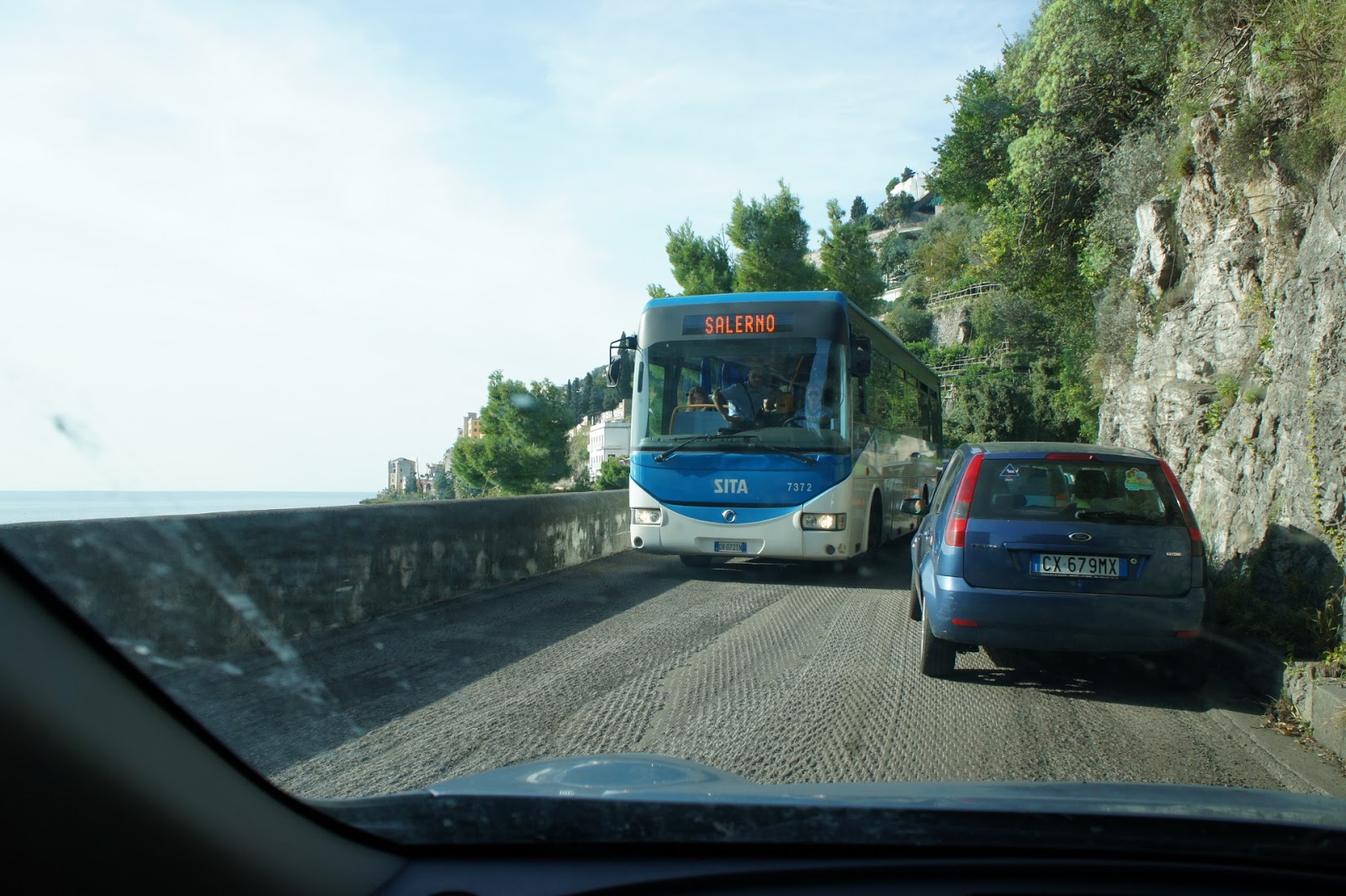
A bus squeezing past oncoming traffic
Despite hearing that the coastal mountain roads in Italy were narrow and dodgy, we found the way to Amalfi to be in fantastic condition, with reassuringly solid barriers made of rock on the edge of the road. Definitely an improvement on what we’d seen years ago in Eastern Europe, and also India and Nepal.

After depositing our car in a (literally and figuratively) cool carpark which had been dug into the side of the mountain and felt like some sort of Bond villain lair, we navigated some crazy tunnels to descend into the town proper. Once we emerged on the other side,
I felt like we had stepped into a postcard - the sparkling blue seas, the charming narrow laneways - Amalfi is the very embodiment of picturesque. And we really couldn’t have had better weather.
Amalfi
Amalfi cathedral
I bet that 80% of tourists can't resist taking a photo of this
In fact, the only bad thing about the whole day was my ill-fated attempt to send a postcard. Sometimes the word ‘lazy’ or ‘sleepy’ is used interchangeably with ‘charming’ or ‘quaint’ to describe a town, like it’s a good thing. Unfortunately in the case of Amalfi, lazy could also be used to describe the attitude of the staff in the local post office. Basically I (and two other tourists) ended up waiting more than half an hour just to buy some stamps for a postcard - and not because they were short-staffed either, but simply because some of them just couldn’t be stuffed helping out, even though they clearly had nothing better to do. 

I really should have cut my losses and left after 10 minutes, but you know when you get to that stage where you think ‘oh, I’ve already waited so long, I’ll just keep waiting...’ or ‘surely it can’t be THAT much longer..?’ Maybe this explains why I didn't bother sending any more postcards for the rest of the trip. Or, it's just as likely to be sheer laziness. Either way, if you were one of the two lucky people who got a postcard from me on this trip, count yourself lucky!

That aside, Amalfi is beautiful and definitely worth the visit. Just don’t bother getting stamps from the post office.
Main beach at Positano

After Amalfi we drove on to have lunch at Positano, another lovely settlement perched above the glittering Mediterranean. Unfortunately nearly everything was shut either due to the time of day or just the fact that it was November, but it was still nice to snap some photos and tick it off the list.

Overall, the Amalfi Coast totally lived up to my expectations in terms of beauty. A lot of people also recommended we visit the Cinque Terre, and though it is a UNESCO site and definitely on my list of places to go, we simply didn't have enough time on this trip, so will have to leave it for the next visit. I wonder how they compare?
Me with the UNESCO sign
[Flickr set here]

Naples

What would you do with three weeks in Europe? After much indescision, we decided on an ambitious grand tour of Italy (with a wee bit of the UK thrown in) which would knock 25 UNESCO World Heritage sites off our list.
We first became aware of UNESCO World Heritage sites in 2006, when we noticed the same logos popping up at various tourist attractions around Eastern Europe. What began as a running photo joke escalated into a full blown obsession, with a spreadsheet keeping track of how many we’d visited compared to the rest of the family.

I guess it was inevitable that this would eventually culminate in a trip more or less planned entirely around visiting UNESCO sites. And what better country to choose than Italy, which boasts more UNESCO sites than any other in the world?


Our goal was to pick up a rental car in Naples, drive up the coast via Rome, Florence and Venice, plus all the UNESCO sites in between, then return it in one piece in Milan. This is what happened.


Historic Centre of Naples

From the Neapolis founded by Greek settlers in 470 B.C. to the city of today, Naples has retained the imprint of the successive cultures that emerged in Europe and the Mediterranean basin. This makes it a unique site, with a wealth of outstanding monuments such as the Church of Santa Chiara and the Castel Nuovo - http://whc.unesco.org/en/list/726
Unlike Rome (the colosseum), Florence (the duomo) or Venice (Piazza San Marco, that bridge), Naples doesn’t really have a thing which is iconic - something you to go, take a photo of/with, and go, right, I’ve ticked Naples off the list. If anything, I guess it would have to be the narrow streets in the historic centre. And eating a pizza.
Naples at its most atmospheric - at night
Our first stop in Naples was Da Michele, allegedly Naples’ most famous pizzeria. It was already after two o’clock when we found the place after dumping our rental car and bags at our B&B in Ercolano, about half an hour out of town by train. After getting a numbered pink slip from the grumpy old man at the till, we waited patiently for a table with the rest of the tourist crowd.
Hapless tourists waiting to sample a famous Napoli pizza
Since the dawn of TripAdvisor, Zagat, Chow, and restaurant review sites in general, waiting patiently for a table at a culinary hotspot is now par for the foodie course. I once waited two hours for a breakfast in San Francisco which ultimately turned out to be fairly disappointing, despite my determination to love it. I really don’t know what’s worse, paying too much or waiting too long for average/crappy food... why do people do it? I guess it’s a perfect encapsulation of ‘FOMO’ or Fear Of MIssing Out.

Anyway, after we were finally squeezed in, we waited patiently for our table to be cleared. Then we waited patiently for someone to take our order. Then we waited very, very patiently for our pizzas to arrive. It took freaking ages. Every attempt to flag down a harried waiter failed utterly. While this was our first formal introduction to what southern Italians call customer service, I had an inkling something had gone awry when a table of Italians abruptly deserted their tables in disgust, and by all appearances left without paying for their drinks, after having had enough. In the end, while we never found out what caused the delay, we suspected we had become collateral damage in some sort of employment relations disagreement.


I didn’t count the minutes but it would have been well over an hour from when we arrived to finally getting our pizzas. Which, by the way, took about 30 seconds to assemble and about 5 minutes to cook, judging by what I could see of the kitchen (when it was going). By the time we had the slices in hand we were absolutely starving, so the first mouthful was amazing - hot, tomato-y, cheesy, chewy.

Unfortunately it went a bit downhill from there.

As we quickly began to learn throughout our meals in Italy, there was a very close, inverse relationship between the tastiness of pizza/pasta, and its temperature. By the time we were halfway through it was a stone cold, sloppy, unappetising mess, and in the end we had to give up without finishing the whole lot.


Overall, I’m sad to say that my first experience with ‘authentic’ Neopolitan pizza will be memorable not for its culinary merits. I’m not sure how things would have turned out differently if we’d gone to the other famous pizzeria, Gino Sorbillo, or found somewhere else, but to be honest with a good recipe (like this for dough and this for sauce), I would say that anyone could match - or perhaps even beat - the deliciousness of ‘real’, Napoli pizza at home.

Another random photo of Naples at night
The next night, while trying to catch the train back to Ercolano, we managed to get embroiled in more strike action, this time by the train drivers. As more and more people arrived and realised the trains were going nowhere, an angry mob started to form around the drivers’ break room, where they were handing out notices presumably explaining the strike action.
It's a shame I couldn't get a shot which truly captured the passion of the crowd, but I was trying to remain unobtrusive
Of course, I couldn’t understand a word but I imagined the gist of the argument to go something like ‘we’re going on strike because we want more pay and benefits, even though the European economy is going down the gurgler and we can hardly afford it’ and ‘How could you do this, we have no way of getting home now, get off your lazy asses and drive the trains, dammit!’

If you’ve never seen Italians argue in real life, it’s pretty much exactly how it’s stereotypically depicted in movies and TV shows - lots of hand gestures and shouting. The fact that I was worried it might turn into a riot aside, it was all pretty amusing. Certainly one of those ‘had to be there, money-can’t-buy’ cultural experiences.


Thankfully, the drivers eventually caved and decided to go back to work after all, to everyone’s immense relief.

On the more positive side, Naples certainly lived up to expectations when it came to the ambience of the streets, especially at night. A highlight was the subterranean tour, which took us into the tunnels and chambers under the city. True to local form, the tour ended up starting about 20 minutes late for no apparent reason, and we were forced to wait around. The most fun was of course the part where we all got to carry a candle and shuffle along a narrow walkway for about a hundred metres.
Some of the narrow tunnels in the subterranean tour
I know that some people think it’s more ‘authentic’ to visit ‘gritty’ places like Naples, and that the graffiti and terrible customer service is part of its charm, but as a whole it could probably do a lot better for itself, and draw more of the crowds from further north by cleaning itself up a bit.

Overall, while I wouldn't rank Naples up there with New York and Budapest in terms of 'favourite cities I've ever visited', it's still worthwhile to go at least once, and a perfect place to base yourself to explore the other attractions (i.e. UNESCO sites) in the region.

[Flickr set of Naples here]